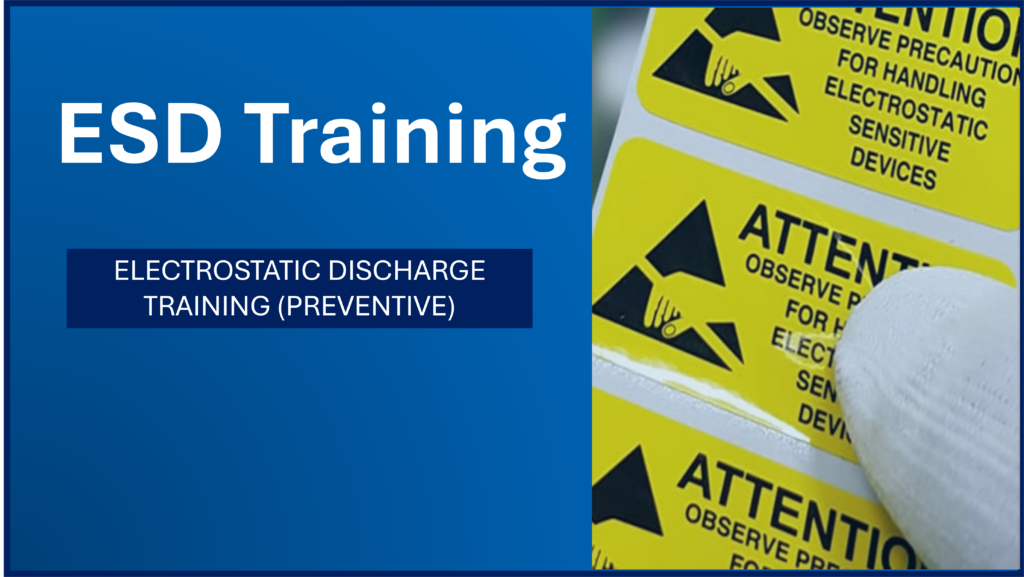
This Electrostatic Discharge (ESD) course is designed to introduce you to the fundamental concepts and practical controls of electrostatic discharge as it applies to aviation environments.
With IEC 61340-5-1 as the foundational reference, the course prepares individuals involved in the inspection, assembly, repair, handling, storage, and testing of electrical and ESD-sensitive aircraft components to understand what ESD is, why it matters, and how to manage it safely and effectively.You will learn how static electricity is generated, how discharges occur, the risks they pose to sensitive parts, and the strategies and standards used to prevent ESD damage in day-to-day operations.
Training videos are followed up with practice question. These question slides are included in the training to test your knowledge, skills and attitude towards EWIS. At the end of the course you will receive a final examination. For both you need to pass with a score of 75% or more
Course Objectives:
The content of this course is intended to be used as guidance material for developing or improving an organization-specific electrostatic discharge prevention program. It may be used as a reference when tailoring ESD prevention measures to the organization’s activities and operational environment. Responsibility for defining, implementing, and maintaining ESD control measures remains with the organization.
Learning objectives:
After completion of this course, the students will:
- Understand the basic principles of electrostatic discharge, including how static electricity is generated, accumulated, and discharged.
- Recognize ESD-sensitive components and equipment commonly used in aircraft maintenance and component repair environments.
- Identify potential ESD hazards and risk situations during handling, inspection, assembly, repair, storage, and testing activities.
- Apply appropriate ESD control measures and protective practices in accordance with established standards and organizational procedures.
- Demonstrate correct handling and management of electrostatic discharge sensitive components and devices within an aircraft technical environment.
Regulatory requirement compliance:
This course is developed with NEN-EN-IEC 61340-5 section 1 and 2 as reference.
Prerequisites:
A background in an aviation environment is an advantage although not essential.
Course Topics:
This course has been divided in 4 major parts, all covering different content.
PART 1: STATIC ELECTRICITY FUNDAMENTALS
- What Static Electricity is
- How Static Electricity is generated
- What Electro Static Discharge is
- The effects of Electro Static Discharge
- Conductors, Insulators and Static dissipative materials
- The behaviour of static electricity on conductors and insulators
PART 2: ELECTROSTATIC DISCHARGE
- The definition of ESD
- Occurance of ESD
- The result of uncontrolled ESD
- Control of ESD
- Components in aviation that are ESD sensitive and how to recognize them
PART 3: ESD STANDARDS
- Relevant regulations on ESD programs to the aviation industry
- Relevant ESD (industry) standards to ESD sensitive equipment
- Who uses ESD standards
- Why to use ESD standards
PART 4: STRATEGIES FOR ESD PREVENTION
- ESD prevention strategies:
- with the individual
- on the aircraft
- on the workbench
- throughout the facility
- for storage and handling
- for transportation
- related to marking
PART 5: FINAL EXAMINATION (30 MCQ)
Course Duration:
This Advanced E-training courses takes about 4-5 hrs to complete.
Materials Used
Required Materials:
TPlease download the ASA Best Practice Handling of ESD Sensitive Parts for Distributors (download here).
Supplemental Materials:
A notebook and pen if you require to make notes.
Hardware and Software Requirements
Hardware requirements:
A reliable computer with a stable internet connection is necessary to complete the course and/or online examination.
Software requirements:
There is no software deemed necessary for this training.
Browser information:
We recommend that you use Google Chrome during the course and online examination.
Instructor & Training Material Author Information
Instructor & Training Material Author credentials:
Mr. Danny Goergen is a highly experienced aviation professional with over two decades of expertise spanning aircraft maintenance, regulatory compliance, quality assurance, training, and consultancy. His career has been defined by a commitment to excellence in safety, operational efficiency, and industry best practices.
Starting as an aircraft mechanic, Danny honed his technical skills before earning a Bachelor of Science in Aviation Engineering. He then transitioned into process engineering at an EASA Part 145 approved component repair shop, where he played a pivotal role in optimizing maintenance operations. Over the years, he has held multiple EASA Form 4 positions, including Technical Manager and Quality Assurance Manager, demonstrating his ability to lead and uphold rigorous industry standards.
In 2009, Danny founded Holland Aviation Consultancy & Engineering (HACE), a firm dedicated to providing expert consultancy, audit support, and training services to the aviation maintenance sector. Through HACE, he has developed an online training platform offering courses in Human Factors, EWIS, Fuel Tank Safety, and aviation regulations, ensuring that professionals worldwide have access to high-quality, industry-relevant education.
Danny’s extensive experience includes quality management roles in EASA Part 145 maintenance organisations, Part 147 training centers, and Aircraft Part-Out and Aviation Supplier organisations. As a lead auditor and compliance expert, he has been instrumental in ensuring organizations meet and exceed regulatory requirements. His work with MROs, training organisations, and aerospace firms has positioned him as a trusted advisor in regulatory compliance, safety management, and continuous improvement.
Beyond consultancy, Danny is a qualified and experienced auditor and has provided internal audit support for numerous organizations, such as APOC, Chromalloy, EPCOR, Fokker Services Group, Intelsat and Viba Aerospace & Defense. His expertise covers not only EASA, FAA, and CAAC regulations, but also ISO-9001, EN/AS9120, ASA-100 and AFRA BMP standards, allowing him to navigate complex international compliance landscapes effectively.
As a respected trainer and mentor, Danny has conducted numorous classroom and online training sessions for aviation professionals, equipping them with the knowledge and skills to uphold the highest industry standards. His ability to translate regulatory requirements and aviation standards into practical, actionable strategies makes him a valuable asset to any aviation organization.
With a passion for aviation safety and continuous improvement, Danny Goergen remains dedicated to supporting the industry’s evolving needs through expert consultancy, quality management, and training solutions.
Contact information:
Mr. Danny Goergen can be contacted via e-mail (danny.goergen@hace.aero) or tefephone +31(0)28183203
Linked-in: https://www.linkedin.com/in/dannygoergen/
Assessment and Grading
Testing procedure:
Students will perform an online examination with Multiple-choice questions. A laptop or tablet with a steady WiFi/internet connection is needed to complete this examination.
Grading procedure:
All lessons need to be marked completed and the online examination needs to be passed with a minimum passrate of 75% in order to receive a Certificate of Course Completion.
Assignments and Participation
Assignments and Projects:
There are no assignments or projects applicable for this online course.
Course Ground Rules
Course Participation & Expectations
To ensure a smooth and effective learning experience in this self-paced course, students are expected to:
- Engage with course materials actively and complete all required activities.
- Utilize available resources, including instructor support (if applicable), FAQs, and discussion forums.
- Stay updated on course announcements and guidelines.
- Use the designated student email for any course-related communication.
- Address any technical issues promptly to avoid disruptions.
- Follow proper online etiquette (netiquette) in all interactions within the learning platform.
By following these guidelines, students can maximize their learning experience and successfully complete the course.