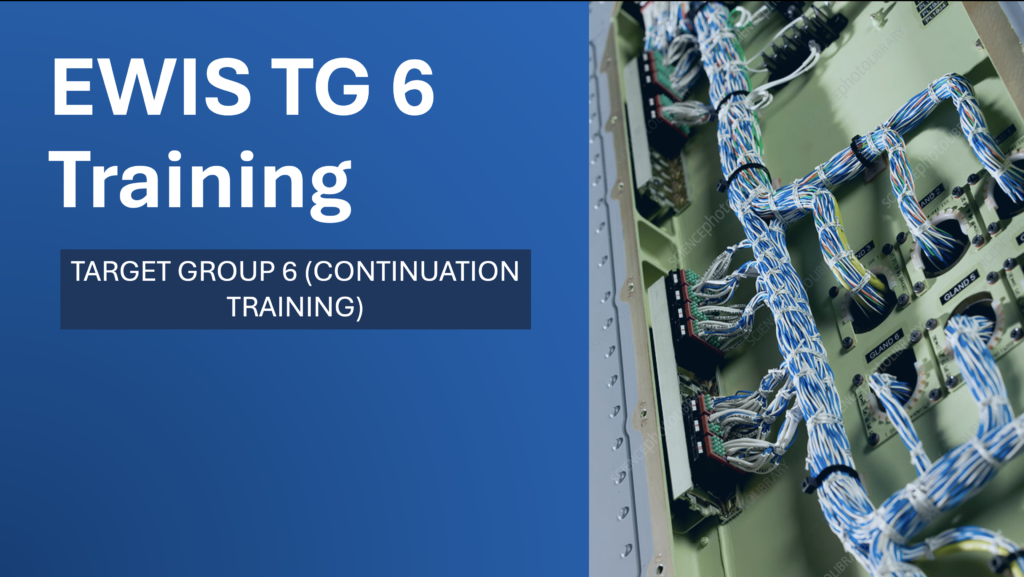
This continuation training course refreshes EWIS safety awareness for service staff whose duties bring them near aircraft wiring.
The course reinforces safe working practices, recognition of typical damage, contamination prevention, housekeeping and cleaning precautions. Students review the examples against their work experience and current task instructions.
Course Objectives:
The objective is to maintain the EWIS awareness needed for safe service activities near aircraft wiring.
The course reinforces recognition and reporting of abnormal conditions and encourages students to identify where familiarity, procedural deviations or changes in working conditions could increase the risk of inadvertent damage.
Intended Audience
Target Group 6: Other service staff with duties in proximity to electrical wiring interconnection systems.
Examples include:
- Aircraft cleaning personnel.
- Cargo loading personnel.
- Fuelling personnel.
- Lavatory servicing personnel.
- De-icing personnel.
- Pushback personnel.
The employing organisation determines the applicable target group from the employee’s actual duties.
Learning objectives:
After completing this course, students should be able to:
- Recognise electrical hazards associated with service work near aircraft wiring.
- Explain how service activities and human factors can affect wiring integrity.
- Recognise obvious examples of wiring damage at awareness level.
- Identify external, internal and other contamination sources.
- Explain housekeeping principles and precautions for authorised cleaning near wiring.
- Recognise typical causes of degradation and relevant aircraft areas.
- Report abnormal conditions and recognise when an activity exceeds their authorisation.
Regulatory requirement compliance:
The course is developed around the Target Group 6 syllabus in EASA AMC 20-22 Appendix B, supported by the relevant curriculum topics in Appendix C:
- A.1 — Safety practices.
- C.16 — Wiring system damage, at low level.
- D.17, D.18 and D.19 — External, internal and other contamination sources.
- D.22 — Cleaning processes.
- E.27 — Typical damage and areas found, at low level.
The course supports the organisation’s EWIS training programme. Aircraft-specific familiarisation, current task instructions and local reporting arrangements supplement the generic training.
Prerequisites:
- Sufficient English to understand the lessons and questions.
- Basic workplace safety awareness appropriate to the service role.
Previous EWIS training or an aircraft maintenance licence is not required.
Course Topics:
This course has been divided in 4 major parts (out of the 6 main parts of the EWIS TG 1 & 2 training), all covering different content.
PART 1 – GENERAL EWIS PRACTICES
- Wiring integrity and aircraft airworthiness.
- Direct and indirect electrical hazards.
- Electrical injuries and obtaining qualified assistance.
- Aircraft electrical power safety.
- Circuit breaker precautions.
- Human factors and compliance with procedures.
PART 3 – INSPECTION
- Recognition of typical wiring damage.
- Foreign object debris and metal shavings.
- Mechanical damage and hot-gas exposure.
- Fluid contamination, vibration and chafing.
- Corrosion and overheating.
- Relevant aircraft areas and reporting observations.
PART 4 – HOUSEKEEPING
- External, internal and other contamination sources.
- Foreign object debris and damage.
- The protect and clean as you go philosophy.
- Cleaning precautions.
- Selection of applicable cleaning materials and processes.
- Task limits and referral to authorised personnel.
PART 5 – WIRE
- Aging and wiring degradation.
- Vibration, moisture and corrosion.
- Heat and chemical contamination.
- Indirect damage.
- Damage caused by personnel traffic and equipment.
- Typical aircraft areas and safe service behaviour.
Course Duration:
This Advanced E-training courses takes about 2 hrs to complete.
Materials Used
Required Materials:
Easy Access Rules for Acceptable Means of Compliance for Airworthiness of Products, Parts and Appliances (AMC-20) (Amendment 11) (download here)
Supplemental Materials:
A notebook and pen if you require to make notes.
Hardware and Software Requirements
Hardware requirements:
A reliable computer with a stable internet connection is necessary to complete the course and/or online examination.
Software requirements:
There is no software deemed necessary for this training.
Browser information:
We recommend that you use Google Chrome during the course and online examination.
Instructor & Training Material Author Information
Instructor & Training Material Author credentials:
Mr. Danny Goergen is a highly experienced aviation professional with over two decades of expertise spanning aircraft maintenance, regulatory compliance, quality assurance, training, and consultancy. His career has been defined by a commitment to excellence in safety, operational efficiency, and industry best practices.
Starting as an aircraft mechanic, Danny honed his technical skills before earning a Bachelor of Science in Aviation Engineering. He then transitioned into process engineering at an EASA Part 145 approved component repair shop, where he played a pivotal role in optimizing maintenance operations. Over the years, he has held multiple EASA Form 4 positions, including Technical Manager and Quality Assurance Manager, demonstrating his ability to lead and uphold rigorous industry standards.
In 2009, Danny founded Holland Aviation Consultancy & Engineering (HACE), a firm dedicated to providing expert consultancy, audit support, and training services to the aviation maintenance sector. Through HACE, he has developed an online training platform offering courses in Human Factors, EWIS, Fuel Tank Safety, and aviation regulations, ensuring that professionals worldwide have access to high-quality, industry-relevant education.
Danny’s extensive experience includes quality management roles in EASA Part 145 maintenance organisations, Part 147 training centers, and Aircraft Part-Out and Aviation Supplier organisations. As a lead auditor and compliance expert, he has been instrumental in ensuring organizations meet and exceed regulatory requirements. His work with MROs, training organisations, and aerospace firms has positioned him as a trusted advisor in regulatory compliance, safety management, and continuous improvement.
Beyond consultancy, Danny is a qualified and experienced auditor and has provided internal audit support for numerous organizations, such as APOC, Chromalloy, EPCOR, Fokker Services Group, Intelsat and Viba Aerospace & Defense. His expertise covers not only EASA, FAA, and CAAC regulations, but also ISO-9001, EN/AS9120, ASA-100 and AFRA BMP standards, allowing him to navigate complex international compliance landscapes effectively.
As a respected trainer and mentor, Danny has conducted numorous classroom and online training sessions for aviation professionals, equipping them with the knowledge and skills to uphold the highest industry standards. His ability to translate regulatory requirements and aviation standards into practical, actionable strategies makes him a valuable asset to any aviation organization.
With a passion for aviation safety and continuous improvement, Danny Goergen remains dedicated to supporting the industry’s evolving needs through expert consultancy, quality management, and training solutions.
Contact information:
Mr. Danny Goergen can be contacted via e-mail (danny.goergen@hace.aero) or tefephone +31(0)28183203
Linked-in: https://www.linkedin.com/in/dannygoergen/
Assessment and Grading
Testing procedure:
Students will perform an online examination with Multiple-choice questions. A laptop or tablet with WiFi internet connection is needed to complete this examination.
Grading procedure:
All lessons need to be marked completed and the online examination needs to be passed with a minimum passrate of 75% in order to receive a Certificate of Course Completion.
Assignments and Participation
Assignments and Projects:
There are no assignments or projects applicable for this online course.
Course Ground Rules
Course Participation & Expectations
To ensure a smooth and effective learning experience in this self-paced course, students are expected to:
- Engage with course materials actively and complete all required activities.
- Utilize available resources, including instructor support (if applicable), FAQs, and discussion forums.
- Stay updated on course announcements and guidelines.
- Use the designated student email for any course-related communication.
- Address any technical issues promptly to avoid disruptions.
- Follow proper online etiquette (netiquette) in all interactions within the learning platform.
By following these guidelines, students can maximize their learning experience and successfully complete the course.