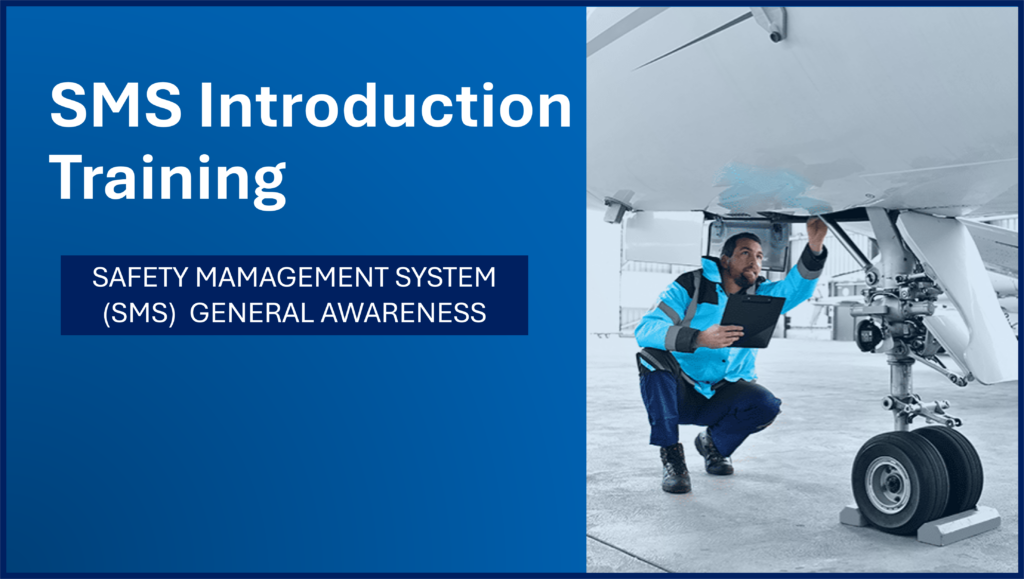
This course introduces participants to the key tools to manage a performance-based SMS. Participants will become able to review, evaluate, build, or improve upon a safety management plan.
The course details the safety management provisions and the implementation of a Safety Management System (SMS) at service provider level, respectively.
This course is developed with ICAO annex 19 and ICAO doc 9859 3rd Edition Safety Management Manual (SMM) as reference and is intended for personnel assigned to safety and safety-related positions in an aviation maintenance organisation or to those who would like a comprehensive review of SMS fundamentals.
Course Objectives:
The objective of this course is to obtain a suitable level of SMS related knowledge in order to become able to review, evaluate, build, or improve upon a safety management plan. For those from organizations that already have safety programs, the trainee will be able to critically review, compare and contrast, evaluate, and improve existing plans and programs from a safety management system perspective and make the required improvements.
Learning objectives:
This advanced E-training will provide you with the following skills:
- Learn how the process of risk management can increase the effectiveness of your accident prevention efforts.
- Being able to deal with management at all levels and how to promote a Safety Management System and subsequent safety programs, using the basic concepts of strategic planning.
- Being able to communicate effectively with and involve all levels of management in safety by understanding the benefits and need of a Safety Management System.
- Being able to involve all staff in safety, develop a positive safety culture, maintain a commitment to safety, and assess progress.
- Being able to evaluate your current safety program and identify gaps or deficiencies compared to a fully functioning Safety Management System.
This advanced E-training will provide you with the following attitude:
- Being aware of the Safety Management System principles and theories.
- Being aware of different cultures in the Safety Management System Environment.
- Having the willingness to take into account human and organizational factors, as you organize (or reorganize) for a Safety Management System.
Regulatory requirement compliance:
This course is developed with ICAO annex 19 and ICAO doc 9859 4th Edition Safety Management Manual (SMM) as reference.
Prerequisites:
- Have a general understanding of safety concepts and programs in a Part-145 maintenance environment.
- Familiarity with information security principles is beneficial but not mandatory.
- Proficiency in English for technical and regulatory materials.
Course Topics:
PART 1 – SAFETY MANAGEMENT
- What causes accidents
- The defenition and concept of Safety
- The definition of Safety Management Systems
- The basic Safety Management System requirements
- Management strategies for Safety Management
- Basic Safety Concepts
PART 2 – HAZARDS – FOUR FUNDAMENTALS
- Types of Hazards
- Identifying Hazards
- Analyzing Hazards
- Documenting Hazards
PART 3 – SAFETY RISKS
- Definition of Risk
- Five fundamentals of Risk Management
- Managing Safety Risks
PART 4 – INTRODUCING SAFETY MANAGEMENT SYSTEM (SMS)
- Why een organisation needs a Safety Management System
- How an SMS relates to what you are already doing
- The four components of SMS in your organisation
- Safety Policy and Objectives in a Safety Management System
- Safety Risk Management and the way to implement it
PART 5 – SAFETY ASSURANCE AND PROMOTION
- How to assure Safety
- Safety Reporting System
- Internal evaluations and audits
- Organizational Cultures
- Promoting Safety
Course Duration:
This Advanced E-training courses takes about 8 hrs to complete.
Materials Used
Required Materials:
We recommend that you purchase ICAO Annex 19 (latest edition here) and download (free) the ICAO doc 9859 3rd Edition.
Supplemental Materials:
A notebook and pen if you require to make notes.
Hardware and Software Requirements
Hardware requirements:
A reliable computer with a stable internet connection is necessary to complete the course and/or online examination.
Software requirements:
There is no software deemed necessary for this training.
Browser information:
We recommend that you use Google Chrome during the course and online examination.
Instructor & Training Material Author Information
Instructor & Training Material Author credentials:
Mr. Danny Goergen is a highly experienced aviation professional with over two decades of expertise spanning aircraft maintenance, regulatory compliance, quality assurance, training, and consultancy. His career has been defined by a commitment to excellence in safety, operational efficiency, and industry best practices.
Starting as an aircraft mechanic, Danny honed his technical skills before earning a Bachelor of Science in Aviation Engineering. He then transitioned into process engineering at an EASA Part 145 approved component repair shop, where he played a pivotal role in optimizing maintenance operations. Over the years, he has held multiple EASA Form 4 positions, including Technical Manager and Quality Assurance Manager, demonstrating his ability to lead and uphold rigorous industry standards.
In 2009, Danny founded Holland Aviation Consultancy & Engineering (HACE), a firm dedicated to providing expert consultancy, audit support, and training services to the aviation maintenance sector. Through HACE, he has developed an online training platform offering courses in Human Factors, EWIS, Fuel Tank Safety, and aviation regulations, ensuring that professionals worldwide have access to high-quality, industry-relevant education.
Danny’s extensive experience includes quality management roles in EASA Part 145 maintenance organisations, Part 147 training centers, and Aircraft Part-Out and Aviation Supplier organisations. As a lead auditor and compliance expert, he has been instrumental in ensuring organizations meet and exceed regulatory requirements. His work with MROs, training organisations, and aerospace firms has positioned him as a trusted advisor in regulatory compliance, safety management, and continuous improvement.
Beyond consultancy, Danny is a qualified and experienced auditor and has provided internal audit support for numerous organizations, such as APOC, Chromalloy, EPCOR, Fokker Services Group, Intelsat and Viba Aerospace & Defense. His expertise covers not only EASA, FAA, and CAAC regulations, but also ISO-9001, EN/AS9120, ASA-100 and AFRA BMP standards, allowing him to navigate complex international compliance landscapes effectively.
As a respected trainer and mentor, Danny has conducted numorous classroom and online training sessions for aviation professionals, equipping them with the knowledge and skills to uphold the highest industry standards. His ability to translate regulatory requirements and aviation standards into practical, actionable strategies makes him a valuable asset to any aviation organization.
With a passion for aviation safety and continuous improvement, Danny Goergen remains dedicated to supporting the industry’s evolving needs through expert consultancy, quality management, and training solutions.
Contact information:
Mr. Danny Goergen can be contacted via e-mail (danny.goergen@hace.aero) or tefephone +31(0)28183203
Linked-in: https://www.linkedin.com/in/dannygoergen/
Assessment and Grading
Testing procedure:
Students will perform an online examination with Multiple-choice questions. A laptop or tablet with WiFi internet connection is needed to complete this examination.
Grading procedure:
All lessons need to be marked completed and the online examination needs to be passed with a minimum passrate of 75% in order to receive a Certificate of Course Completion.
Assignments and Participation
Assignments and Projects:
There are no assignments or projects applicable for this online course.
Course Ground Rules
Course Participation & Expectations
To ensure a smooth and effective learning experience in this self-paced course, students are expected to:
- Engage with course materials actively and complete all required activities.
- Utilize available resources, including instructor support (if applicable), FAQs, and discussion forums.
- Stay updated on course announcements and guidelines.
- Use the designated student email for any course-related communication.
- Address any technical issues promptly to avoid disruptions.
- Follow proper online etiquette (netiquette) in all interactions within the learning platform.
By following these guidelines, students can maximize their learning experience and successfully complete the course